Bruno Schulz is an outstanding writer, artist and graphic artist. He was born in the quite interesting city — Drohobych. Bruno Schulz was so amazed with the city that he describes it in his works 'Sanatorium under the Sign of the Hourglass','The cinnamon shops' and others.
Our city boasts of such people and that is why we have made up a special route for tourists to find out something more about this prominent person.
Railway Station
1 Zluky Square · GPS: 49.354926, 23.542671 · Map
Railway Station (1 Zluky Square). Bruno Schulz often made use of its services during his trips to Poland and abroad. The Drohobych railway station is mentioned in 'The Street of Crocodiles' from his Cinnamon Shops.
The Street of Crocodiles
Stryiska str · GPS: 49.352169, 23.538184 · Map
According to the schulzologists, 'The Street of Crocodiles' is located in modern Ivana Mazepy and Stryiska Streets. One of the stories from Cinnamon Shops is under the same title. Schulz called the Street of Crocodiles as a peripheral, parasitical quarter and a sign of civilization that spoiled the city.
Former old Jewish cemetery
Pylypa Orlyka str · GPS: 49.362057, 23.513637 · MapLocation of the former old Jewish cemetery (Pylypa Orlyka Street; now the residential quarter). Here Bruno Schuz’s parents, Jakub and Henriette, were buried. According to some recollections, Bruno Schulz could be buried here as well. But according to the most probable version, the artist was buried in the collective grave in the new Jewish cemetery (at the end of Pylypa Orlyka Street) along with other victims of 'Black Thursday' — the bloody Nazi German action against Jews on 19 November 1942.
Former Jewish hospital
8 Pylypa Orlyka str · GPS: 49.353941, 23.511610 · Map
Former Jewish hospital (8 Pylypa Orlyka Street; now the kindergarten №30). Here Bruno Schulz was periodically treated from 1940 to 1942.
Choral Synagogue
6 Pylypa Orlyka str · GPS: 49.353431, 23.510955 · Map
Choral Synagogue (6 Pylypa Orlyka Street). Probably, Bruno Schulz went to synagogue, but it is unknown how often. Schulz’s family didn’t belong to the Orthodox Jews. In February 8, 1936, Bruno Schulz officially withdrew from the Jewish Religious Community and took on the status of 'non-believer' until his death.
House where lived Bruno Schulz’s fiancée
36 Lesi Ukrainky str · GPS: 49.355633, 23.506378 · Map
House where lived Bruno Schulz’s fiancée, Józefina Szelińska, during her stay in Drohobych (36 Lesi Ukrainky Street; now the house).
Former house of Zbigniew Moroń
10 Ivana Chmoly str · GPS: 49.356621, 23.505732 · Map
Former house of Zbigniew Moroń (10 Ivana Chmoly Street; now the house). During the German occupation, Bruno Schulz hid in the cellar of this house when Felix Landau, who was the so-called 'protector' of the artist until his tragic death, was outside the city.
Former Jewish orphanage
46 Lesi Ukrainky str · GPS: 49.355925, 23.503979 · Map
Former Jewish orphanage (46 Lesi Ukrainky Street; now the Faculty of History of the Drohobych University). Izydor Schulz, Bruno Schulz’s brother, was one of the builders as well as engineers who constructed the orphanage in 1911–1913. According to Bruno Schulz’s pupils, here he made drawings on the ceiling of one of the rooms during the German occupation.
Former King State Gymnasium
24 Ivana Franka str · GPS: 49.354924, 23.501368 · Map
Former King Władysław Jagiełło State Gymnasium (24 Ivana Franka Street; now the main building of the Drohobych University). Here Bruno Schulz studied from 1902 to 1910 and his teacher of drawing was Adolf Arendt whom the writer immortalized in his prose. Here Schulz worked as a teacher of drawing and manual arts from 1924 to 1939. Since November 2003 in his former professorial office near the former workshop, there is Bruno Schulz Museum founded by the Centre for Polish Studies of the Drohobych University which substantially takes care of it. This is the first Bruno Schulz Museum in Ukraine as well as in the world.
Bianca’s villa
38 Tarasa Shevchenka str · GPS: 49.354200, 23.498806 · Map
'Bianca’s villa' (38 Tarasa Shevchenka Street; now the Palace of Art, department of the Drohobych Museum of Local Studies). Bianca’s villa is described in Bruno Schulz’s 'Spring'. Here are displayed Schulz’s murals found in the so-called Landau’s villa in 2001. The famous schulzologist Władysław Panas (1947–2005) identified this Palace, founded in the early 20th century, with Bianca’s villa, described by Schulz.
Landau’s villa
14 Tarnavskoho str · GPS: 49.353679, 23.496360 · Map
'Landau’s villa' (14 Tarnavskoho Street; now the apartment building). During the German occupation of Drohobych, here lived SS Hauptscharführer Felix Landau with his family. By his order, Bruno Schulz painted pictures based on fairy tales on the walls of one of the rooms. Five fragments of these paintings found in 2001 were given to the Drohobych Museum of Local Studies and the other three were taken out of Ukraine and now they are exhibited in the Yad Vashem Museum in Israel.
Former Jewish nursing home
27 Tarasa Shevchenka str · GPS: 49.353488, 23.499866 · Map
Former Jewish nursing home (27 Tarasa Shevchenka Street; now the Drohobych City Viacheslav Chornovol Library). Here in 1942 Schulz catalogued books confiscated by the Soviets and then by the Germans. Besides, he served as an evaluator of the robbed works of religion, literature and art.
Former villa of Raymond Jarosz
23 Tarasa Shevchenka str · GPS: 49.353417, 23.500692 · Map
Former villa of Raymond Jarosz, major of Drohobych (23 Tarasa Shevchenka Street; now the Faculty of Biology of the Drohobych University). Raymond Jarosz was a mayor of Drohobych and co-owner of the Truskavets resort. He supported Bruno Schulz financially. During the German occupation, the villa housed a military casino in which, according to the recollections of witnesses, Schulz painted his pictures on the walls. During the Soviet occupation, here was the Pioneer Palace.
Former editorial office of the 'Bolshevik Truth' newspaper
14 Tarasa Shevchenka str · GPS: 49.353090, 23.503280 · Map
Former editorial office of the 'Bolshevik Truth' newspaper (14 Tarasa Shevchenka Street; now the editorial office of the 'Galician Dawn' newspaper). In 1940–1941 Bruno Schulz made illustrations for the Drohobych regional newspaper 'Bolshevik Truth'. Besides the thematic drawings, he painted portraits of Ivan Franko as well as Taras Shevchenko for this newspaper.
Judenrat
7 Tarasa Shevchenka str · GPS: 49.352590, 23.503257 · Map
House of the German Department of Jewish affairs, or 'Judenrat', during the German occupation (7 Tarasa Shevchenka Street; now the apartment building). According to the recollections of witnesses, the German officer Karl Günter killed Bruno Schulz in front of this building on 19 November 1942.
Former Bertold Schenkelbach’s photo studio
3 Adama Mickiewicza str · GPS: 49.352211, 23.502143 · Map
Former Bertold Schenkelbach’s photo studio (3 Adama Mickiewicza Street; now the house). The Drohobych photographer Bertold Schenkelbach, a friend of Bruno Schulz, gave him light-struck photographic plates on which Schulz created his graphic works from The Book of Idolatry in cliché verre technique in 1920–1922. Not far from the photo studio, there was a residence of the Schenkelbachs which is still preserved (32 Yuriy Drohobych Street).
Former private Henryk Sienkiewicz Gymnasium
11 Adama Mickiewicza str · GPS: 49.351522, 23.501560 · Map
Former private Henryk Sienkiewicz Gymnasium (11 Adama Mickiewicza Street; now the apartment building). Here Bruno Schulz’s fiancée, Józefina Szelińska, worked from 1930 to 1934.
House Bruno Schulz
12 Yuriya Drohobycha str · GPS: 49.351285, 23.502401 · Map

House where Bruno Schulz lived from 1910 to 1941 (12 Yuriya Drohobycha Street; in Schulz’s times: Bednarska Street, then Florianska Street; in the Soviet times: Sedova Street; now there are apartments in this house). The owner of the house was Bruno Schulz’s sister, Hanna Hoffman. After World War II, a part of Schulz’s letters was found in its attic.
St. Bartholomew’s Church
12 Danyla Halytskoho str · GPS: 49.351967, 23.504349 · Map


St. Bartholomew’s Church (12 Danyla Halytskoho Street). Bruno Schulz used to go to this church with his pupils.
Place where Bruno Schulz was shot
Tarasa Shevchenka str · GPS: 49.352696, 23.504911 · Map

Place where Bruno Schulz was shot (Tarasa Shevchenka Street). During the 2nd International Bruno Schulz Festival, thanks to the partners from Lublin, the commemorative plaque was placed here on 19 November 2006 but later it was stolen; the next plaque was placed on 19 November 2010. Every year on this place on the anniversary of Bruno Schulz’s death, there is an ecumenical prayer involving Ukrainians, Poles and Jews.
Bruno Schulz’s family house
2 Market Square · GPS: 49.351834, 23.505297 · Map
Former location of Bruno Schulz’s family house (2 Market Square) where he lived from 1892 to 1910. On the ground floor housed a textile store of Bruno’s father, Jakub Schulz, called 'Henriette Schulz' and its facade was decorated with Jakub Schulz’s painting in which two merchants who praised their goods were depicted. Schulz’s family house is described in Cinnamon Shops. The house burnt down during World War I.
Former Adam Mickiewicz Secondary School
10 Yaroslava Osmomysla str · GPS: 49.351714, 23.505237 · Map
Former Adam Mickiewicz Secondary School, the so-called white school (10 Yaroslava Osmomysla Street; now the Teachers’ House). Here Bruno Schulz studied and then worked from 1933 to 1934.
City Hall
Market Square · GPS: 49.351444, 23.506252 · Map
City Hall. The tower of the city hall is depicted in many paintings and drawings of Bruno Schulz. During Raymond Jarosz’s presidency, his office was decorated with the paintings of the artist. During the first Soviet occupation in 1939–1941, thematic paintings and portraits of the government officials painted by Bruno Schulz were hung up on the city hall.
Former Gorgoniusz Tobiaszko’s pharmacy
15 Market Square · GPS: 49.351315, 23.507305 · Map
Former Gorgoniusz Tobiaszko’s pharmacy (15 Market Square), mentioned in Bruno Schulz’s 'August'. It is considered to be the beginning of 'the Street of Crocodiles'.
Bruno Schulza Street
Schulza str · GPS: 49.351648, 23.510139 · Map

Bruno Schulza Street. In 2001 it was named after the artist’s name on the initiative of Maria Galas, head of the Polish Cultural and Educational Society, called 'Renaissance'.
Drohobych regional department of the NKVD
3 Stryiska str · GPS: 49.351776, 23.512517 · Map
Former location of the Drohobych regional department of the NKVD from 1939 to 1941 (3 Stryiska Street; now the Institute of Physics, Mathematics, Economy and Innovation Technologies of the Drohobych University). According to some sources, here in 1940 Schulz was arrested on the accusation of Ukrainian nationalism as he used too much blue and yellow in his painting on the theme of 'the liberation of the people of Western Ukraine', which he produced on the orders of the local authorities.
Professional School for Girls
12 Zavallia str · GPS: 49.350130, 23.507483 · Map
Former Eliza Orzeszko Professional School for Girls, the so-called red school (12 Zavallia Street; now the secondary school №3). Here Bruno Schulz worked as a teacher of drawing from 1936 to 1938.
Holy Trinity Church
2 Truskavetska str · GPS: 49.349406, 23.506499 · Map
Holy Trinity Church (2 Truskavetska Street), depicted in Bruno Schulz’s Sanatorium Under the Sign of the Hourglass as well as in his graphic works from The Book of Idolatry.
Drohobych saltworks
27 Solonyi Stavok str · GPS: 49.348341, 23.496613 · Map


Drohobych saltworks (27 Solonyi Stavok Street). Bruno Schulz writes about saltworks in his “Cinnamon Shops” from the collection under the same title.
St. George’s Church
25 Solonyi Stavok str · GPS: 49.347917, 23.499412 · Map
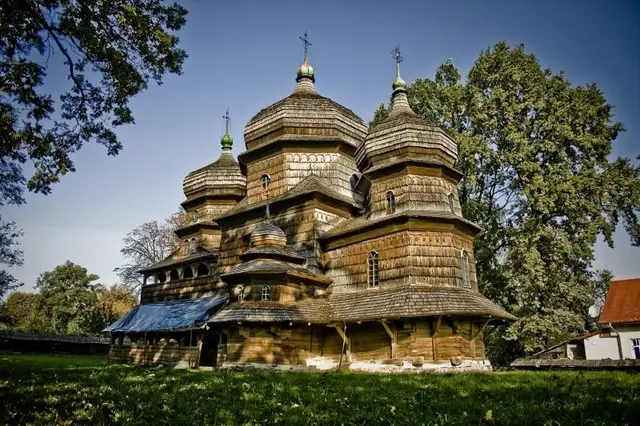
St. George’s Church (25 Solonyi Stavok Street). Bruno Schulz used to go to this church with his pupils, giving them lectures on the history of art.
Leon Sternbach Co-Educational Gymnasium
28 Markiyana Shashkevycha str · GPS: 49.347513, 23.504773 · MapFormer private Leon Sternbach Co-Educational Gymnasium, its second seat (28 Markiyana Shashkevycha Street; now the College of Statistics). Here Bruno Schulz taught drawing in the 1930s and then drafting from 1939 to 1941.
Cemetery
Truskavetska str · GPS: 49.344449, 23.507948 · Map
Cemetery on Truskavetska Street. Here there is a gravestone made by the Drohobych sculptor Ignacy Lobos on the grave of Jan and Maria Lobos. The gravestone was designed by Bruno Schulz.
Location of a sawmill of the Kuhmerkers
69 Truskavetska str · GPS: 49.340619, 23.509708 · MapLocation of a sawmill of the Kuhmerkers (69 Truskavetska Street; now the 'Dnister Ltd' company). The family of Henriette Kuhmerker, Bruno Schulz’s mother, traded in timber and owned a steam sawmill.
Former Putz Inn
120 Truskavetska str · GPS: 49.338867, 23.510155 · MapFormer Putz Inn (120 Truskavetska Street; the Hill). The inn on the Hill, described by Bruno Schulz in 'The Republic of Dreams'.